Banana Flavoured Easter Kit Kats

One of my favourite things about living in Japan is getting to try seasonal Kit Kats. Looks like this year for Easter we’re getting banana flavour.

Thanks Jesus!

Since Easter isn’t a holiday officially celebrated in Japan, I only realise it’s happening because of the Easter themed candy that pops up around this time of year. It seems to have been combined with the coming of spring (my work calendar does suggest that the spring equinox is a national holiday), into bright pastel imagery of eggs and bunnies and budding flowers.

The back of the package said there were 12 designs in total. I got 9 different ones and 3 repeats

I’m a total sucker for banana and chocolate combined, so I was pretty excited for these guys. Flavourwise I would have appreciated some more chocolate – Kit Kat gimmick flavours are generally white chocolate based, and while I do appreciate the bright yellow spring-y chocolate this allows for, I think this is one that would have benefited from prioritising a stronger chocolate flavour over aesthetic. While the package does claim that the ingredients include real banana, the flavour is definitely close to the typical artificial banana flavour – the one that’s based on a type of banana that’s gone extinct, and only lives on in its candy form. They do have a much more distinct taste than a lot of the white chocolate based Kit Kats – often the advertised flavour will just be noticeable in a vague hint in the aftertaste, but these were decidedly banana.

So bright and spring-y

In a previous year, the Easter Kit Kat – I believe it might have been apple pie flavoured – came in a bunny shape rather than the traditional two sticks. In one end there was extra chocolate to form a face, and the stick shapes made out the ears. It was quite adorable, but it did make it harder to break the two pieces apart. So, I can see why the traditional shape would be preferable for those out there who aren’t filthy heathens who shove the entire thing in their face in one go.
Overall I enjoyed these, and when I come home today I think I’ll try eating them at the same time as some darker chocolate, to achieve my crunchy chocolatey bananaesque dreams.

Why are Some Japanese Animals Counted with “Head”?

Small animals in Japanese are counted with 匹 hiki. Large animals are counted with 頭 tou. Rabbits are counted as if they were birds, because logic.

Back in the olden days, all animals were 匹. When doing my pre-writing double-check-googling just now, I found one source that suggests this kanji gets its shape from a horse butt. Oh that makes sense, you much too optimistically think, I bet that’s because it’s used for counting horses, right? Weeeell… it used to be, but then English came along and ruined everything with its fancy phrases worth stealing.

I couldn’t find any confirmation for the following, but my more literate friend told me this a while back:

Natsume Souseki, also known as that guy with the mustache who used to be on 1000 yen bills until he was dethroned by that guy with the floofy hair, is the person who popularised 頭 as a counter for large animals. I did find confirmation that it was popularised in the Meiji era, and of its English origins. When counting cows, they’re counted with heads of cattle. My farming lingo isn’t up to scratch so I’ll take google’s word for it. Our boy Natsume Souseki decided this sounded really neat, and decided to count that way in one of his novels; 頭 is read as tou when used as a counter, but it can also be read atama, which means “head”. Ever since, tou has been used for large animals, and hiki for small ones.

Small animals, except for rabbits, that is. Rabbits are a special case, and are counted with 羽 wa. My dictionary tells me that when read hane, this means “feather” or “wing”. Wa happens to be the counter for birds, so the feathers and wings make sense. There aren’t any definitive answers as to why rabbits are counted as birds, but there are a couple prevalent theories. The first is that the Japanese words for “to fly” and “to jump” are pronounced the same (tobu, I believe the kanji are 飛ぶ for to fly and 跳ぶ for to jump, although I might be mistaken and they’re both 飛ぶ). This theory is generally countered with “frogs tho, they jump but are counted with 匹”. The second theory suggests that once upon a time, there were a group of monks. They weren’t allowed to eat animals, only bird meat. But, they really wanted to get in on some rabbit meat action, so they declared that rabbits are totally a kind of bird.

Counting Japanese Books

One of the first kanji most Japanese students learn is 本. It’s nice and non-intimidating, with only 5 strokes. Plus, you need it to write “Japan” and “Japanese”, so you’ll need it for getting fancy and titling your notebook 日本語 or letting everybody know that you’re 日本語を勉強しています. While it has a bunch of meanings, you easily remember that one of them is “book” because books are made of trees and this kanji is only one stroke away from the one for “tree”, plus it means “origin” too and books originate from trees, and everything is nice and logical and you’ve totally got a great grasp on this whole situation.

Now you, hypothetical strawman reader, have advanced in your studies. You’ve just discovered the complexity of Japanese counters. Instead of everything being “one thing, two things”, there are all these different suffixes you gotta learn depending on the thing you’re counting. One flat object, two small animals, three big animals (yup, big and small animals have different counters. It’s America’s fault, I think I’ll write about that next). Skimming the list of counters, you finally see one you recognise. 本! Of course, this must be how you count books! After all, it does mean book!

NOPE.

本, hon, is the counter for “long, cylindrical objects”. You know what’s neither long nor cylindrical? That’s right, books. The correct way to count books is 冊 satsu. And speaking of kanji pronounced “satsu”, there’s also 札 which means bill (as in 千円札, 1000 yen bill). I just tried to look up whether bills would be counted with 札, or with 枚 (the counter usually used for paper and other flat objects like pizza), but googling 千円札 数え方 just gave me video demonstrations of how to do that fancy bill flicking counting thing they do in stores here. My old manager tried to teach me once, but gave up upon realising I’m cripplingly left-handed. Digressions aside, let’s think about long cylindrical objects.

Oh, I know! You naïvely exclaim, dear strawman, how about chopsticks! Those are long and cylindrical, right? Next time your Japanese friends act amazed that you managed to transfer a whole piece of food all the way from your plate into your mouthhole without incident, you can further blow their minds with some amazingly accurate counting skills, and count the chopsticks with 本 hon.

Oh my sweet summer child.

No? Not hon? Oh of course, chopsticks come in pairs. They must use soku 足, the counter for pairs! Wrong again. Just like books are important enough to get their own special counter (bet you didn’t think my digressions would come full circle), chopsticks also get their own words. If you wanna sound really impressive, count them with 膳 zen, that’s 一膳 ichizen per pair.

Finally, let me leave you with a story about counting pairs. You may have recognised the counter for pairs as the kanji for foot, when read ashi. In Japanese class, we learned this meaning much earlier than we learned it as a counter. My classmate once saw a pair of shoes for sale. The price tag stated the price per 足. As we were not yet aware of the “pairs” meaning, she assumed that price per 足 = price per foot, i.e. the sign was listing the price per shoe and the pair would cost twice as much. I do love the idea of going to the store to buy a single shoe.

Sakura Chocolate Milk with Strawberry Jelly

Valentine’s day has passed, which means it’s time for stores to replace the chocolate with more spring-themed sweets. I found this drink at the Family Mart by work.

That’s sakura and chocolate flavoured milk with strawberry jelly. I do find the packaging quite attractive.

As for the flavour, it tasted about as appetizing as it sounds, honestly – it was like sweetened milk with chunks in it. I couldn’t really taste the sakura (not that I’m quite sure what that should taste like anyway), and definitely didn’t taste the chocolate. The jelly added a texture that made my boyfriend compare it to curdled milk.

It was an enlightening experience and I’m gonna stick to my ice coffees for now.

The Most Useful Japanese Word

On my quest for conversational fluency in Japanese, there’s a single word that’s taken me from bumbling hesitancy to native-like speeds. It cut out my foreigner-esque mid-sentence thinking breaks and has my back whenever my vocab is lacking. Also, it’s wildly anticlimatic; it’s basically “stuff”. やつ (yatsu) – I’m honestly not quite sure how it differs from 物 (mono) and 事 (koto), the words we usually learn for “thing”. I think maybe it’s more conversational, or perhaps 物 and 事 are usually parts of other words while やつ can be used alone.

Whenever I don’t know the proper name for something, instead of taking a mid-sentence dictionary break or trying to formulate a long-winded explanation, I can just point to “that thing” and move on. As a bonus, my conversational partner is rather likely to tell me the name of the thing, and I get a free new vocab word with none of the dictionary using effort. Combine it with adjectives for an even more impressive display of feigned fluency (あの大きいやつ、この赤いやつ, that big thing, this red thing).

I think that when speaking a foreign language, the most important thing is to be comfortable to listen to. Nobody wants to wait around as I take long breaks of visible struggle, trying to formulate the perfect sentence with all the correct words and perfect grammar. It’s much more pleasant to listen to someone who speaks at a regular pace, even if there is an excessive use of “thing”. Also, everybody knows that I’m not a native speaker, and in general people are quite understanding of that.

My last “nihongo jozu” was earned at starbucks, when I wanted a protective cardboard sleeve for my hot cup and asked for “あの紙のやつ” (that paper thingy). And honestly, does anybody even know the proper word for those in English?

Valentine’s Day in Japan

In japan, it is tradition for ladies to give chocolate to the men in their lives. This is not just limited to romantic interests – one is also expected to buy 義理チョコ (“giri choco”, which I believe translates to something like “social obligation chocolate), to male coworkers. This is my first valentine’s I’ve had a job, so I bought some chocolate to give to my coworkers tomorrow.

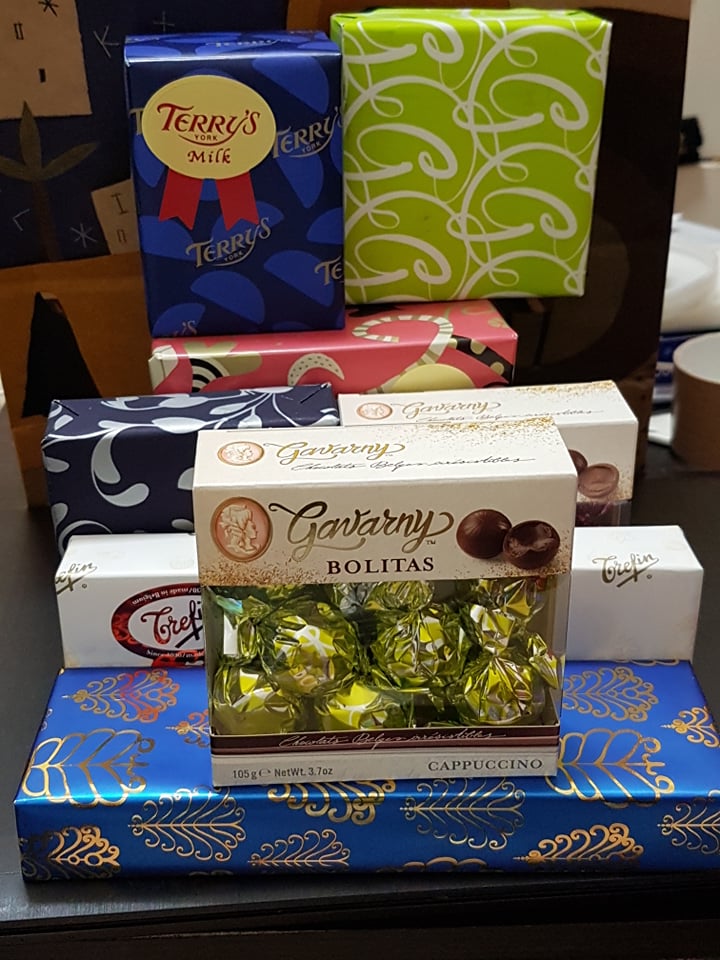
Okay so only 2 of these are actually for work – the 2 unwrapped ones. The rest are for my boyfriend, because I’m horribly indecisive and also he’ll end up sharing most of it with me anyway, so really I just indirectly bought myself a bunch of prettily wrapped chocolate.

They all had the option of being purchased pre-wrapped or not (I just chose to get the ones for work sans wrapping so I could remember which they were). They cost around 400 yen each (just below 4 dollars I believe). The most expensive one is the one in the upper right corner; it’s a Terry’s Chocolate Orange, and foreign products tend to be outrageously priced here. This one was around 700 yen. Google tells me that’s about 5 pounds, a far cry from the £1 ones I once witnessed on a vacation to Edinburgh, and still long for.

If I ever move again, it will be to Britain for the sensibly priced chocolate oranges.